
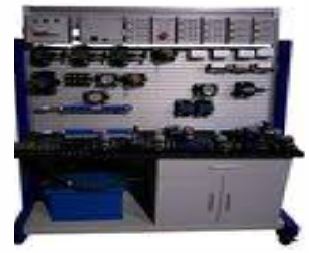
SPECIFICATION
Bank hydrodynamic
Hydraulic Benches
- Dimensions: 3 m * 1.2 m * 1.5 m
- Weight: 300-500 kg
- Power supply: 400 V three-phase, 50 Hz
- Maximum pressure: 10 bar (safety triggered at 12 bar)
- Sensor accuracy: +-0.5% for pressure, +-1% for flow
- Operating temperature: 50C to 400C
Main Components
- Hydraulic System
- Centrifugal or piston pump:
- Power: 1.5 to 3 kW (400 V three-phase power supply).
- Max. flow rate: 50 to 150 L/min (adjustable via frequency inverter).
- Head: 20 to 50 m.
- Reservoir:
- Capacity 200–500 L, stainless steel, with particle filter (25 µm).
- Visible oil level + temperature control thermostat (fluid: water or ISO 32/46 oil).
- Piping:
- Transparent pipes (PVC or polycarbonate) for flow visualization.
- Variable diameters: 20 mm, 40 mm, 80 mm (interchangeable).
- Leak-proof quick-release couplings (camlock type).
- Valves:
- Manual valves (butterfly valve, ball valve).
- Electronic control valves (with 4–20 mA linear actuator).
- Check valve and pressure relief valve.
Instrumentation
- Pressure sensors:
- Analog pressure gauges (range 0–10 bar) + digital transmitters (accuracy ±0.5%).
- Differential sensors for measuring pressure drops (e.g., between two pipe sections).
- Flow meters:
- Magnetic (accuracy ±1%) or ultrasonic (0–150 L/min).
- Analog output (4–20 mA) or USB for data acquisition.
- Thermometers:
- PT100 probe for monitoring fluid temperature (0–80°C).
- Reynolds Counter:
- Module for displaying Reynolds number (laminar/turbulent flow) via an LCD display.
Control and Acquisition System
User Interface:
- Integrated touchscreen for manual control (flow, pressure, temperature).
- USB/Ethernet connectivity for data export.
Acquisition Software:
- Compatible with LabVIEW
- Real-time visualization of pressure/flow curves, pressure drops, and pump efficiency.
Programmable Logic Controller (PLC):
- PID pressure control.
Measurable Experimental Parameters
Regular and Singular Pressure Drops:
- Theory/Experiment Comparison Using the Darcy-Weisbach Formula.
- Study of losses in bends, widenings, and narrowings.
Pump characteristics:
- H-Q curves (head/flow rate) and efficiency as a function of speed.
Flow regimes:
- Visualization of laminar/turbulent flow (with coloring if transparent pipes).
- Calculation of critical Reynolds number.
Valve adjustment:
- Impact on flow rate and pressure losses.
Enquiry Form
Related Product


Tesca specialize in doing turnkey projects that is fully operable when it is handed over to the project authority. Starting from inception to application training, Tesca provides the services as ONE source solution. Working side by side with government authorities and people across the World, we help countries to perform better. We support countries grow their economies, strengthen their education and health systems and improve financial management. We do this by providing consultancy & training in environment safety, education, health strengthening.
Category
Useful Links
Contact Us
International Sales:
 91-9829132777
91-9413330765
India Sales:
91-9588842361
2026 © All Rights Reserved.