
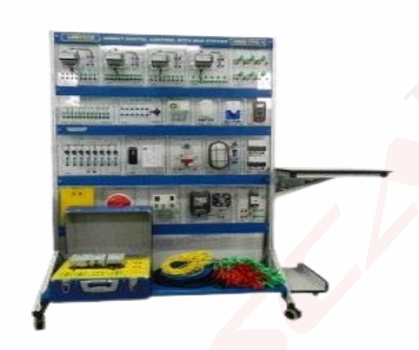
Building Management System Trainer
SPECIFICATION
The Goods requirements are expressed in indicative and functional terms to guide in formulating a cost-effective and appropriate materials and improvement for Technological University of the Philippines Manila Campus. Requirements not mentioned below which are specific or peculiar to the project contractor’s technology solution must only be proposed to improve overall system performance, interoperability, integration, and information exchange.
D.1 Building Management System Trainer
The BMS trainer should be determined by the Project contractor based on the specifications and requirements. Indicative and functional specifications are provided below to serve as guide for the project contractors.
The BMS Trainer shall be a comprehensive, modular, and expandable training system designed to simulate real-world building automation and control systems. It shall demonstrate integration of HVAC, lighting, energy monitoring, access/security, and alarm systems under a unified platform.
Item Description
Building Management System Trainer
System Architecture Requirements
Open-protocol system:
BACnet (required)
Modbus TCP/IP and RTU
Multi-level architecture:
Field Level (sensors/actuators)
Control Level (DDC/PLC)
Management Level (SCADA/BMS server)
Ethernet-based network with IP addressing
Expandable for IoT/cloud integration
Hardware Components
Central Supervisory System
Industrial-grade workstation:
Intel i7 / Ryzen 7 or higher
16–32 GB RAM
Dual monitors (minimum 24”)
Licensed BMS/SCADA software
Data server with:
Trend logging
Alarm database
Historical reporting
Capability for remote monitoring (LAN-based)
Controllers (DDC/PLC)
Programmable controllers
Each controller shall have:
≥16 Digital Inputs / Outputs
≥8 Analog Inputs / Outputs
Support for:
BACnet IP / MS/TP
Modbus TCP/RTU
Programmable using:
Function block / ladder / graphical logic
Human Machine Interface (HMI)
Touchscreen panel (10” minimum)
Real-time system visualization
Control of HVAC, lighting, alarms
Customizable dashboards
Field Devices (Sensors)
Minimum inclusions:
Temperature sensors (room & duct type)
Humidity sensors
CO? / air quality sensor
Light (lux) sensor
Occupancy sensor (PIR)
Actuators and Controlled Equipment
Motorized control valve (2-way or 3-way)
Damper actuator
Additional Modules
Variable Frequency Drive (VFD) for motor simulation
Fan motor module (speed controlled)
Lighting control system (dimmable + relay-based)
Smart energy meter (kWh monitoring)
HVAC Simulation Modules
The trainer must include functional HVAC simulation, such as:
Air Handling Unit (AHU) model
Fan Coil Unit (FCU) simulation
Temperature control loop (closed-loop PID)
(BMS training typically includes HVAC control, lighting automation, and system optimization exercises)
Electrical and Energy Monitoring
Digital power meter (3-phase)
Energy monitoring dashboard
Load simulation bank
Security and Auxiliary Systems (Basic Integration)
CCTV simulation interface (optional)
Access control demo module (RFID-based)
Fire alarm interface (simulation panel)
Communication Network
Managed industrial Ethernet switch
RS-485 network (for Modbus RTU)
Structured cabling with patch panel
Software Requirements
Licensed BMS software platform with:
Graphical floor plan interface
Real-time monitoring and control
Alarm management system
Historical trending and reporting
Controller programming software
Energy analytics module
Multi-user access capability
Modern BMS platforms provide centralized dashboards, alarms, and remote monitoring capabilities.
Training Capabilities
The system shall support the following experiments:
Core Modules
HVAC control (temperature, fan, damper control)
Lighting automation (manual, scheduled, sensor-based)
Energy monitoring and load management
Alarm handling and fault diagnostics
Advanced Modules
BACnet communication setup
Modbus device integration
PID control tuning
System fault simulation and troubleshooting
Physical Construction
Modular training racks or mobile workstation
Clearly labeled components and wiring
Industrial-grade panel enclosure
Transparent or open layout for visibility
Power Supply
220–240V AC, 60 Hz
Includes
Circuit breakers
Emergency stop button
Overload protection
Enquiry Form
Related Product


Tesca specialize in doing turnkey projects that is fully operable when it is handed over to the project authority. Starting from inception to application training, Tesca provides the services as ONE source solution. Working side by side with government authorities and people across the World, we help countries to perform better. We support countries grow their economies, strengthen their education and health systems and improve financial management. We do this by providing consultancy & training in environment safety, education, health strengthening.
Category
Useful Links
Contact Us
International Sales:
 91-9829132777
91-9413330765
India Sales:
91-9588842361
2026 © All Rights Reserved.