
Creep Testing Machine
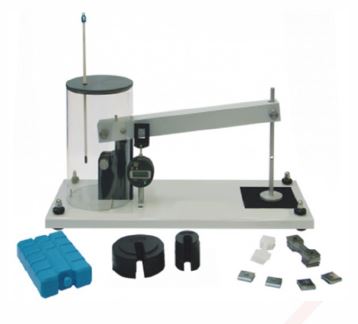
SPECIFICATION
Key features –
A self-contained bench mounting machine which demonstrates the phenomenon of creep under
different conditions and in different materials
- Ideal for student use and classroom demonstrations
- Demonstrates the three phases of creep
- Demonstrates effect of temperature on creep
- Compact and easily stored
- Supplied with weights and test specimens
- Inexpensive specimens readily available in lead and plastics
- Completely self-contained – needs no other parts
Experiments
- The normal breaking load of a specimen over a fixed time
- Relationship between breaking load and time for lead specimens
- Time extension curves to show the three phases of creep (primary, secondary and tertiary)
- The effect of temperature on the creep rate of specimens
- Creep recovery
Standard Features
- Supplied with comprehensive user guide
- Manufactured in accordance with the latest Specifications
- To comprise of a lever and weight machine with a long lever arm and a bearing as a pivot point
- The lever to have a mechanical advantage of 8:1
- A digital displacement indicator to measure the extension of the specimen
- A clear cylindrical enclosure is to surround the specimen area to maintain a constant temperature
- Typical test times for lead specimens to be from 4 minutes to >18 hours at 20oC, depending upon the stress applied
- To be supplied a Laboratory standard thermometer and thermocouple to measure them temperature effects of creep
Weight hanger
- 1x 100 g weight
- 2x 200 g weights
- 3x 500 g weights
Specimens:
- 20x BS1178 lead specimens
- Strain hardening coefficient n = 10
- Activation energy for creep Q = 120 kJ/mol
- 20x polypropylene specimens
- Young’s modulus = 1250 N/mm2
- Time Exponent k = 0.1 to 0.2
- 20x unplasticised PVC specimens
- Net Dimensions and Weight: approx. 570 mm x 430 mm x 220 mm,
- approx. 7.5 kg + 5 kg
weights
- Packed Volume and Weight: approx. 0.1 m3, 15 kg
Enquiry Form
Related Product




Tesca specialize in doing turnkey projects that is fully operable when it is handed over to the project authority. Starting from inception to application training, Tesca provides the services as ONE source solution. Working side by side with government authorities and people across the World, we help countries to perform better. We support countries grow their economies, strengthen their education and health systems and improve financial management. We do this by providing consultancy & training in environment safety, education, health strengthening.
Category
Useful Links
Contact Us
International Sales:
 91-9829132777
91-9413330765
India Sales:
91-9588842361
2026 © All Rights Reserved.