
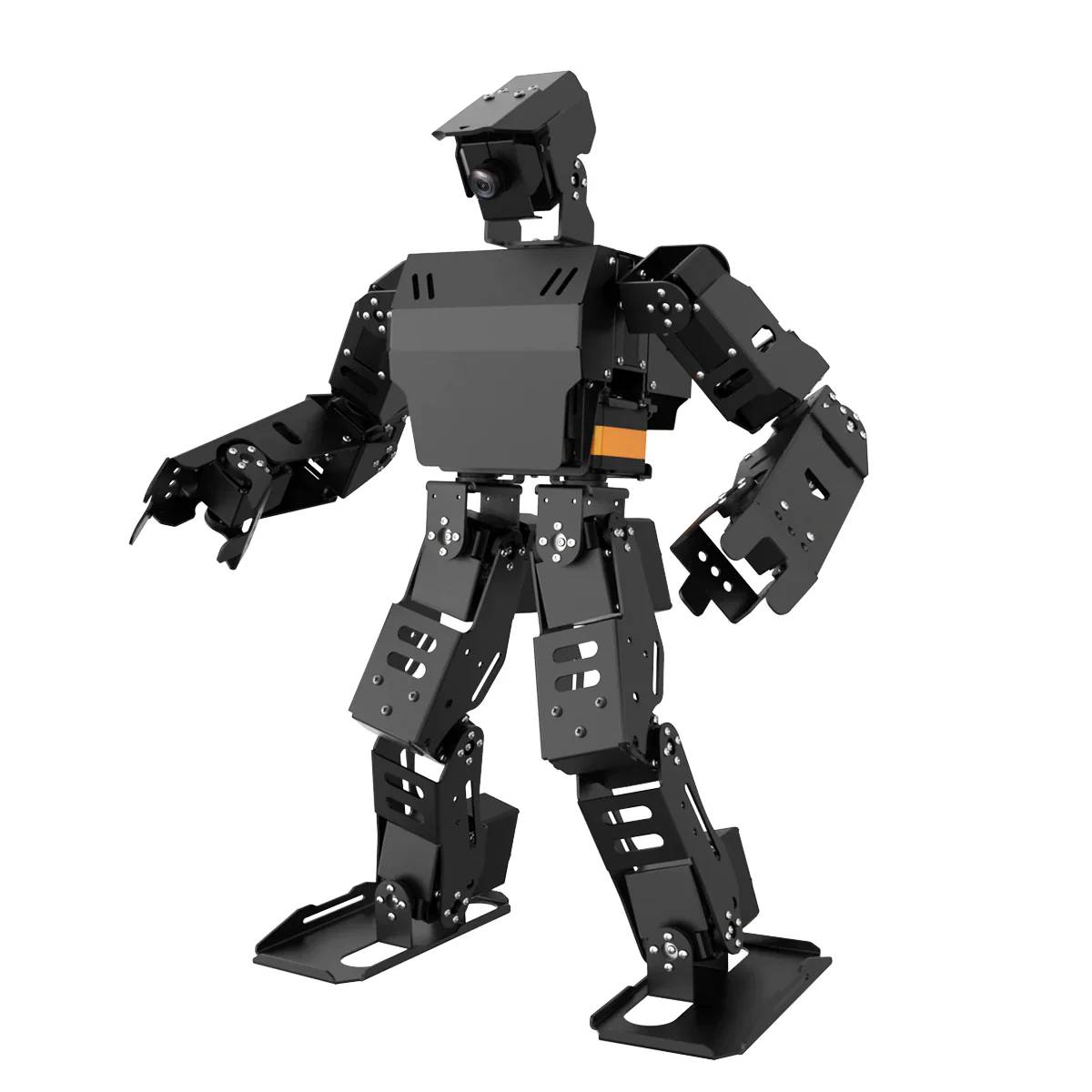
High-Performance Compact Humanoid Robot
SPECIFICATION
Hardware Parameters: ? Full bipedal humanoid (head, torso, two arms, two legs) for Education. ? Degrees of Freedom: Minimum: ≥ 23 DOF, Preferred: ≥ 40 DOF (with hands and waist
articulation). ? Actuation: Electric actuators (servo or PMSM motors) with: High torque density, Low
inertia, and Integrated joint sensing (position + velocity). ? Joint Features: Dual encoders or equivalent high-precision sensing, Backdrivable or
compliant control capability. ? Range of Motion: Human-like joint limits (hip, knee, shoulder, elbow, waist). ? Payload: Arms capable of handling ≥ 2–3 kg. ? Physical Specifications: Height: Approx. 1.2 – 1.4 meters, Weight: ≤ 40 kg, Form
Factor: Compact and portable (preferably foldable or modular), Material: Lightweight
structural frame (e.g., aluminum alloy or composite). ? Mobility & Locomotion: Stable bipedal walking on flat surfaces. Ability to: Maintain
balance under disturbances, Perform turning, stopping, and recovery motions, Support
for: Dynamic locomotion (walking speed ≥ 1 m/s preferred), Experimental locomotion
control (ZMP, MPC, RL). ? Manipulation Capabilities: Arms: Minimum 5–7 DOF per arm, End Effectors: Multi
fingered grippers or dexterous hands (preferred), Control Modes: Position, velocity, and
torque control, Force or impedance control (preferred). ? Sensing & Perception: Vision System: Depth camera (e.g., stereo or structured light), 3D
Perception: LiDAR or equivalent 3D scanning sensor (preferred), IMU: Full-body
inertial measurement unit, Joint Sensors: Position and velocity sensing (mandatory),
Optional: Microphones and speakers (for HRI), Tactile sensing in hands. ? Onboard Computing: High-performance CPU and/or GPU (e.g., NVIDIA Jetson
class or equivalent).
Robot Accessories: ? Battery Type: Rechargeable lithium battery, Sufficient for ≥ 1.5–2 hours operation,
Quick-swap battery system, External charging unit. ? Wireless connectivity (Wi-Fi and/or Ethernet) ? External interfaces: USB / Ethernet / CAN / serial interfaces ? Support for remote teleoperation and monitoring
Software Support: ? ROS / ROS2 compatibility (mandatory). ? SDK for low-level and high-level control. ? Real-time control API. ? Simulation integration (Gazebo / Isaac / equivalent). ? Full documentation and API access ? Support for: Python / C++ programming, Simulation environments ? Optional: Reinforcement learning support, Cloud or edge AI integration. ? Example applications: Locomotion control, Manipulation tasks, AI-based perception.
Enquiry Form
Related Product



Tesca specialize in doing turnkey projects that is fully operable when it is handed over to the project authority. Starting from inception to application training, Tesca provides the services as ONE source solution. Working side by side with government authorities and people across the World, we help countries to perform better. We support countries grow their economies, strengthen their education and health systems and improve financial management. We do this by providing consultancy & training in environment safety, education, health strengthening.
Category
Useful Links
Contact Us
International Sales:
 91-9829132777
91-9413330765
India Sales:
91-9588842361
2026 © All Rights Reserved.