
Refrigeration and air conditioning units
SPECIFICATION
PRODUCT OVERVIEW
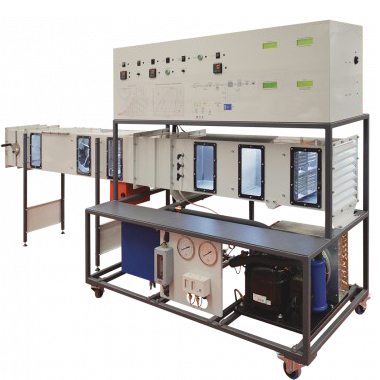
The Advanced HVAC & R Trainer is a versatile, floor-standing unit designed for the in-depth study of heating, ventilation, air conditioning and refrigeration (HVAC & R) systems. It enables students to analyse individual and combined psychrometric processes used in air conditioning, as well as the vapour compression refrigeration cycle, including the use of pressure-enthalpy (P-h) charts.
The trainer is built around two integrated systems: an air handling unit and a water chiller. The air handling unit conditions the air through one or more psychrometric processes, while the water chiller cools water in a storage tank so it can be pumped to a water-to-air heat exchanger within the air handling unit. This chilled water supply provides sensible cooling, combined cooling and dehumidification, or evaporative cooling, depending on the experiment being performed.
Illuminated viewing windows allow every component of each air process to be clearly identified, and temperature and humidity sensors positioned before and after each process allow performance to be evaluated individually or as part of the full system. A control panel provides adjustment of key variables — air flow velocity, temperature and flow rate — to support performance comparisons across different operating set points. The unit also offers onboard data acquisition (DAQ) connectivity via USB, allowing a connected PC running the supplied DAQ software to capture, record and display live data.
Air Handling Unit — Process Train
Air enters through a safety grille and filter before passing through a variable-speed axial fan. The air then moves through a sequence of psychrometric processes:
-
Sensible heating, via a PID-controlled electric pre-heater
-
Steam humidification, using a direct-injection steam humidifier
-
Dry (sensible) cooling, via a 300 mm x 300 mm water-to-air heat exchanger
-
Evaporative cooling, via high-pressure misting nozzles supplied from the chilled water tank
-
Reheating, via a second PID-controlled electric reheater
Water Chiller — Refrigeration System
Housed on the bottom shelf, the refrigeration system cools the water tank that supplies the air handling unit's heat exchanger and evaporative cooler. Its core components are the condensing unit, a thermostatic expansion valve, and a helicoidal evaporator located inside the water tank. Supporting components — a suction line accumulator, filter dryer, liquid receiver, pressure switches and rotolock service valves — protect the system and simplify maintenance. High and low-pressure gauges and transducers, line thermocouples, a refrigerant flow meter and a Watt transducer allow students to evaluate cycle performance against theoretical calculations.
KEY FEATURES
-
Incorporates components used throughout industry for authentic, real-world experimentation
-
Temperature and humidity readings taken around the air duct for each air conditioning process
-
Probe supplied for air flow velocity measurement at stages around the system
-
Pressure, temperature, refrigerant flow rate and compressor electrical power measured around the refrigeration circuit
-
Variable-speed fan enables performance comparison of psychrometric processes at different air flow rates
-
Independent PID-controlled pre-heater and re-heater for precise temperature control and power-input comparisons
-
Direct-injection steam humidifier demonstrates the heat of vaporisation given up to the air stream
-
Variable-speed pump supplies the water-to-air heat exchanger, enabling air-cooling comparisons at different flow rates
-
Hermetic reciprocating compressor chills water for the water-to-air heat exchanger
-
Temperature-controlled chilled water tank enables compressor performance comparisons at different loads and set points
-
In-cut high-pressure spray evaporative cooler connected to the chilled water tank, to study the effect of water temperature on mist evaporation
-
Reaches stability rapidly following a change in operating conditions
-
Onboard Data Acquisition System (DAQ) with USB connectivity
-
LCD display of all measured parameters
-
DAQ software visualises monitored and calculated variables, plus psychrometric and pressure-enthalpy charts, in real time
LEARNING OUTCOMES
Air Handling Unit:
-
Investigation of psychrometrics — definitions, relations and psychrometric charts
-
Real-time plotting of psychrometric processes
-
Understanding of an air handling unit's electro-mechanical components and their function
-
Investigation of psychrometric processes, including:
-
Single-stage: sensible heating, steam humidification, sensible cooling, sensible and latent cooling and dehumidification, adiabatic humidification (evaporative cooling)
-
Multiple-stage: heating and humidification; cooling, humidification and heating
-
-
Observation of the effect of varying fan speed, pump flow rate and temperature settings across the above processes and combinations
-
Calculation of the dew point
-
Evaluation of heat transfer across the water-to-air heat exchanger and the log mean temperature difference (LMTD) driving force
Water Chiller:
-
Understanding of refrigeration components and their function
-
Investigation of the vapour compression refrigeration cycle, including:
-
Real-time plotting of the P-h thermodynamic cycle for refrigerant R134a
-
Calculation of superheat, subcooling, pressure ratio, saturated evaporating temperature and saturated condensing temperature
-
Calculation of the isentropic efficiency of the compressor
-
Calculation of heat balance, mass flow rate and theoretical power of the saturation cycle
-
Calculation of the effect of varying the load on the refrigeration cycle
-
RECOMMENDED ANCILLARIES
Recirculation Duct A recirculation duct can be fitted to the trainer. Air flow through the recirculation unit is varied via manually controlled dampers, allowing a wide range of additional experiments.
-
Key Feature: Dampers allow mixing of air streams at different mass flow rates
-
Learning Outcomes: Determination of mass flow and energy balance across the whole unit; adiabatic mixing of air streams
Environmental Chamber Complementary to the air duct, an environmental chamber can be used to mimic a room. It accommodates a student standing within an environment conditioned by the Advanced HVAC & R Trainer, to assess comfort levels.
-
Key Feature: Allows investigation of thermal human comfort
-
Learning Outcomes: Investigation of HVAC for human comfort applications; calculation of the Predicted Mean Vote (PMV) and Percentage of People Dissatisfied (PPD)
TECHNICAL SPECIFICATIONS:
Operating Conditions
|
Parameter |
Value |
|---|---|
|
Operating Environment |
Laboratory |
|
Storage Temperature Range |
-25°C to +55°C (when packed for transport) |
|
Operating Temperature Range |
+5°C to +30°C |
|
Operating Relative Humidity |
80% at temperatures < 30°C |
Essential Services
|
Parameter |
Value |
|---|---|
|
Min. Operating Space Needed |
5.6 m (width) x 4 m (depth) x 2.2 m (height). Requires min. 1 m inlet clearance in a spacious room. Recommended area of at least 24 m². |
|
Electrical Supply |
Three Phase with Neutral, 380–415 VAC, 50 Hz, 20 A OR Three Phase, 220–240 VAC, 60 Hz, 20 A (Specify on order) |
|
DAQ Software |
PC required (not supplied) — see DAQ datasheet for PC specification |
Dimensions & Weight (Basic Unit)
|
Parameter |
Value |
|---|---|
|
Nett Dimensions |
3.5 m (width) x 0.7 m (depth) x 1.6 m (height) |
|
Mass |
Approx. 650 kg (floor-standing base frame build) |
Enquiry Form
Related Product






Tesca specialize in doing turnkey projects that is fully operable when it is handed over to the project authority. Starting from inception to application training, Tesca provides the services as ONE source solution. Working side by side with government authorities and people across the World, we help countries to perform better. We support countries grow their economies, strengthen their education and health systems and improve financial management. We do this by providing consultancy & training in environment safety, education, health strengthening.
Category
Useful Links
Contact Us
International Sales:
 91-9829132777
91-9413330765
India Sales:
91-9588842361
2026 © All Rights Reserved.