
PIC MICROCONTROLLER BOARD
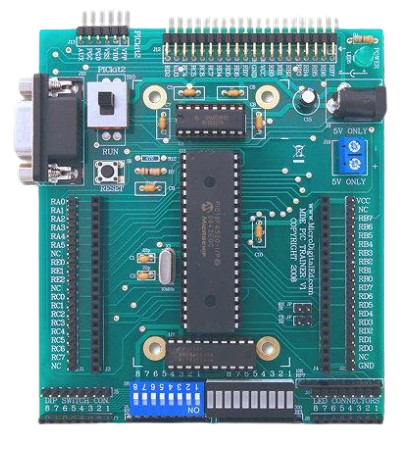
SPECIFICATION
i.Microcontroller: 8-bit PIC16F18877 or superior with Core Independent
Peripherals (CIP) for hardware-based task management.
ii. Language and Software support: multi-language compatibility including
Assembly, C, and high-level graphical programming
environments with full support of industry-standard Integrated
Development Environments (IDEs) and compilers.
iii. PC Connectivity: Micro USB
iv. Debugging Interface: On-board
integrated debugger and programmer supporting real-time
code execution and breakpoints.
v. Operating voltage: Dual-voltage support (5V/3.3V),
user-selectable to accommodate various sensor logic levels.
vi. Power supply: flexible input options via external DC (7.5-12V)
or bus-powered via Micro USB.
vii. Port expansion: Provision of at least five (5) dedicated I/O
port connectors (supporting Ports A, B, C, D, and E) to support
high-density peripheral interfacing.
viii. In-Circuit Test (ICT) Architecture: minimum of 35 digital and
17 analogue diagnostic test points for real-time hardware verification.
ix. In-Circuit Debugging (ICD) Interface: dedicated support for
real-time debugging via at least one (1) Clock line and one (1)
Data line (e.g.: utilizing standard RB6/RB7 architecture).
Enquiry Form
Related Product


Tesca specialize in doing turnkey projects that is fully operable when it is handed over to the project authority. Starting from inception to application training, Tesca provides the services as ONE source solution. Working side by side with government authorities and people across the World, we help countries to perform better. We support countries grow their economies, strengthen their education and health systems and improve financial management. We do this by providing consultancy & training in environment safety, education, health strengthening.
Category
Useful Links
Contact Us
International Sales:
 91-9829132777
91-9413330765
India Sales:
91-9588842361
2026 © All Rights Reserved.